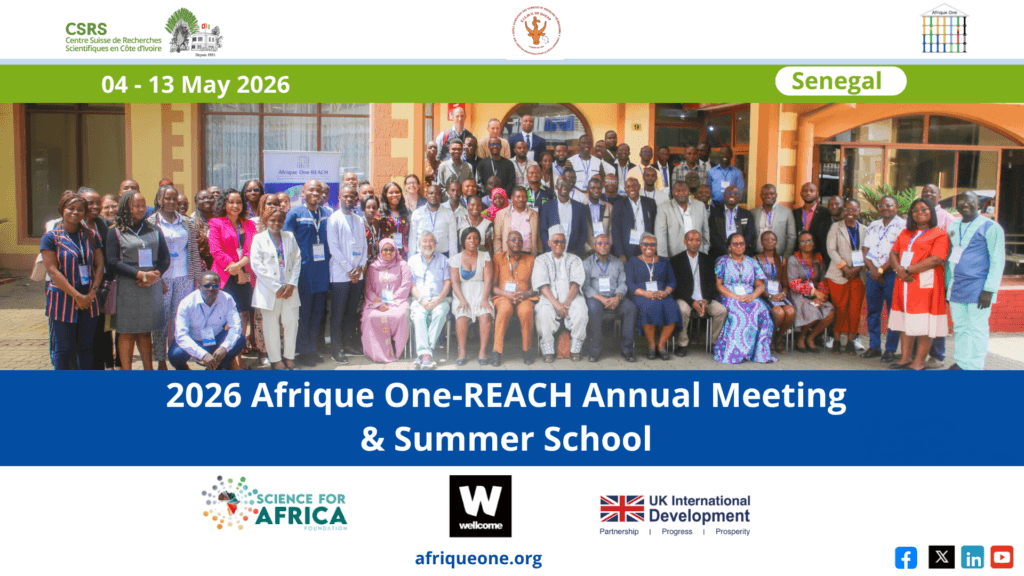
The Management Board Meeting of Afrique One-REACH will be held from 4th to 13th May 2026 in Senegal. The event is hosted by Ecole Inter-Etats des Sciences et Médecine Vétérinaires (EISMV) and co-organized with Afrique One and Centre Suisse de Recherche Scientifique in Côte d’Ivoire. Three key activities will be run during the event: (i) the Annual Management Board Meeting for science, progress reporting and decision-making, (ii) a summer school for fellows and (iii) a site visit for training in policy and community engagement in One Health.
From 9th to 12th May 2026, Afrique One-REACH fellows will present their projects on One Health to the principal investigators (PIs), selected academic supervisors and members of the scientific advisory board. On 13th May 2026, PIs will hold a closed meeting about the future strategic orientation of the consortium and fellows’ career progression.
For the fellows, a summer school will be organized on One Health research projects from 4th to 8th May 2026 with different training modules including a site visit, methods for data analysis, group model building, coaching with own data as well as article writing.
About Afrique One–REACH
Afrique One-REACH (2023-2027) is the third phase of funding of the Afrique One consortium after Afrique One (African Institution Initiative of the Wellcome, 2009-2015), Afrique One-ASPIRE (DELTAS Africa I: African Science Partnership for Intervention Research Excellence 2016- 2022). The objectives of Afrique One-REACH (DELTAS Africa II) are (i) to assess and fill key skills and capacity gaps by offering training to the future African research leaders to implement the One Health approach; (ii) to work towards the systematic integration of different scientific disciplines and sectors (biomedical and veterinary sciences, environmental and social sciences), as well as policy makers, practitioners and communities to find and implement practical and collective public health solutions.